


AI and creative marketing in 2026:
A new role, our nuanced approach, and a deep dive into the Atria AI platform

One of the biggest promises of AI has been its creative abilities. If you’re like the rest of us, you’ve probably been impressed when your AI of choice shoots out a blog post in a matter of minutes, composes a “Taylor Swift song” that could fool anyone, and conjures up a lifelike model using your product. It is undoubtedly impressive.
But we’ve also all seen its shortcomings: By writing a detailed prompt, you essentially wrote the blog post yourself… but better. The Swift song is catchy, but missing not-so-subtle references to her real-life relationships. The model your AI created is growing a strange appendage from her ankle — and worse, she’s downright dead in the eyes.
So while the hype is huge for AI’s generative possibilities, creative teams like ours are carefully navigating what’s truly applicable to our work. At this point in time, our approach to AI use isn’t all or nothing: swear off AI forever or use it to create absolutely everything. Instead, there’s a middle ground that our team — and especially our new AI Creative Specialist — are seeking to define.
AI is shaping new marketing roles
That’s right, we recently created a new role on our creative team focused specifically on integrating AI into our workflows. We recognize that AI isn’t going anywhere and only getting more advanced, so we need a dedicated person to follow these updates, establish and share best practices, and guide our high-producing team toward new efficiencies.
Our new AI Creative Specialist, Kayla Viveiros, is a graphic designer who will continue doing design work while embracing the new role. She says her focus will be “exploring ways to add to our efficiency so the team can be their most creative selves” while also “ensuring that we use AI tools properly and ethically.”
The role will also focus on:
helping the creative team ideate and iterate at scale
organizing performance insights & AI suggestions
researching and vetting new or existing AI tools
implementing tools that are a good fit for the team
maintaining a critical dialog about AI in our work
Kayla continues,
“I want to ensure that AI usage is NOT something that replaces us, but helps us manage our time and frees us up for deeper creative strategy. AI can try its hardest, but it can never replicate our creative minds. It’s best used for organization, research, and analysis, so that we have more time to spend doing the real creative work.
Small generative features like removing backgrounds in Photoshop, adding a voiceover in ElevenLabs, or taking recommendations from Atria to try out for our next iterations are other examples of small but impactful ways we use AI.”
The generative features Kayla calls out above are perfect examples of how our team has adapted AI: as a conglomeration of various tools used for diverse tasks. For example, a designer on our team might leverage Adobe’s generative tools, ElevenLabs’ voiceover generation, and Atria’s analytical features to create a single ad.
You’ve likely heard many marketers say they’re using AI, but few reveal the nitty-gritty process. To explore AI’s true creative capabilities in 2026, we need to dive deeper. We’re here to break the mold and share exactly how our creative team is using these tools, what’s working, and what isn’t.
Here, we break down our experience with Atria — creative examples included!
Atria’s creative-friendly performance reporting
Atria is an AI ad generation, inspiration, and reporting platform. Within it, we can connect our clients’ paid social ad accounts to view top-performing creative themes and metrics, like which video ads are getting the longest views or which copy options have the highest ROAS. This makes it easier for our creative team members to get a high-level understanding of which ads are working, how, and potentially why, without needing the expertise of a seasoned data analyst or media buyer.
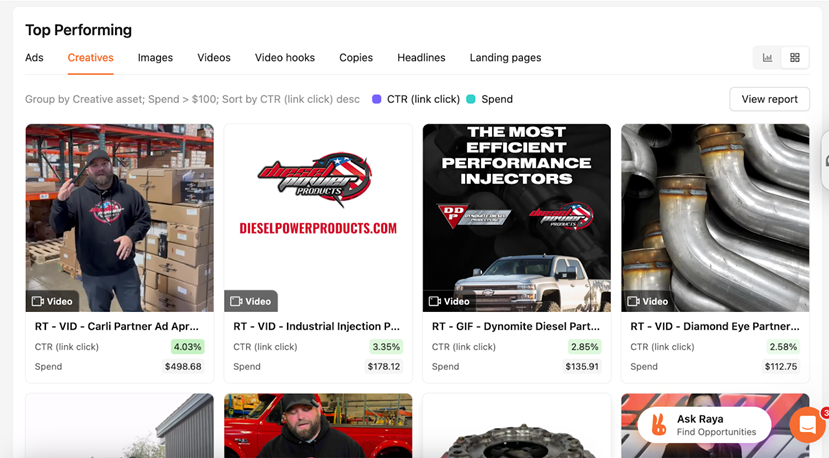
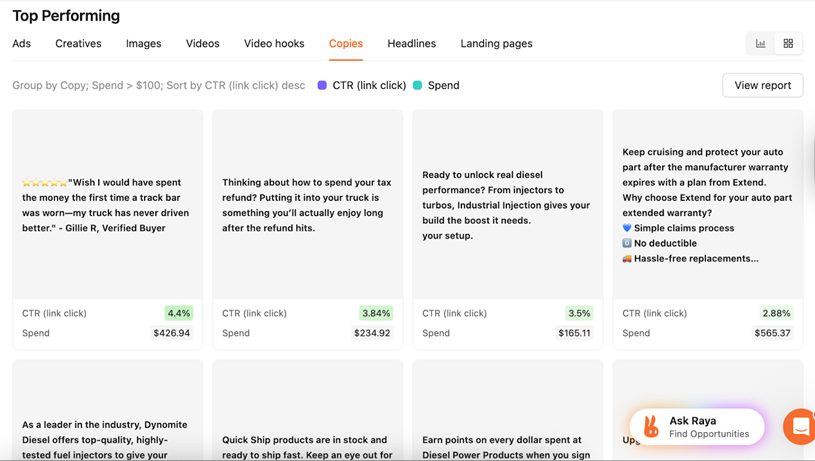
Atria’s more visual user experience, we’ve found, better fits the creatives’ learning styles, portraying designs and text from the ads along with easy-to-understand summaries. This doesn’t replace what our expert data and media buying teams do, but it’s helpful for us to get a snapshot of performance and explore creative results on our own time.
Atria’s ad discovery tools and inspiration boards
Atria also simplifies collecting ad inspiration and competitor creatives. We pull in ads from specific brands, and organize them into boards by brand or vertical. Both our creative and media buying teams use these boards to easily reference and share inspiring ad concepts. It’s essentially moodboarding, but built for paid social.
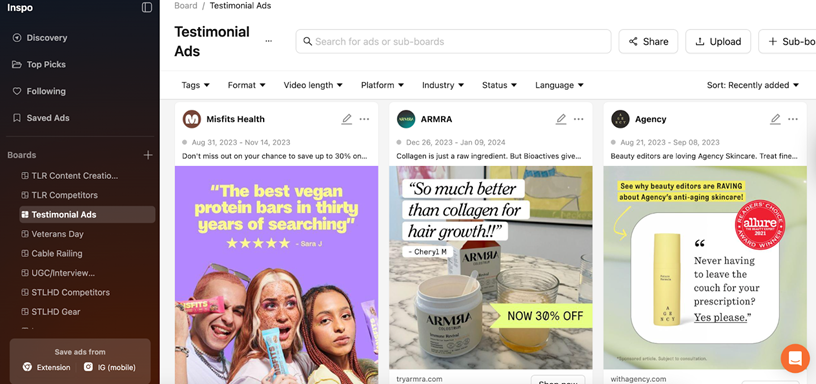
Atria takes the ad discovery another step further, allowing users to download scripts of other brands’ video ads and even generate similar scripts based on them — for an additional price. You can also generate new scripts on your brand’s ads, enabling quick iterations. We’ve had limited experience using this feature, and can’t say whether it generates a script that is fitting for your brand and different enough from the competitor creatives. Other Atria users, let us know!
Atria’s AI ad generation: brainstorming with limitations
Atria offers more than script generation. Like many tech platforms, it’s heavily promoting its wide-ranging generative AI features. Some of Atria’s AI capabilities include:
Auto-generating mockup ads based on your top performers
Generating ad concepts, hooks, and scripts with creative brief prompts
Compiling high-potential ads that could succeed with some tweaks
Recommending edits to ads based on AI-driven performance analysis (E.g., If CTR is low, it may suggest a more urgent CTA and list examples)
Citing other brands’ top-performing ads to back up AI suggestions
NEW since publishing this blog post: Atria began using Nano Banana 2 for their image generation and added refine/edit tools for their clone ads and iterate ads features. Atria has now rolled out new and improved image gen features to give more control over output. We’ll be exploring these improvements and look forward to sharing our experience!
Overall, we’ve found these AI generation features primarily useful for inspiration, but less so for actual ad production. While the iteration suggestions it provides serve as thought-starters and outline different creative routes we could take, we’ve found that we still know our clients’ brands and preferences best.
Here are examples of auto-generated ads Atria created based off of a top-performing static ad for our client, STLHD Gear:
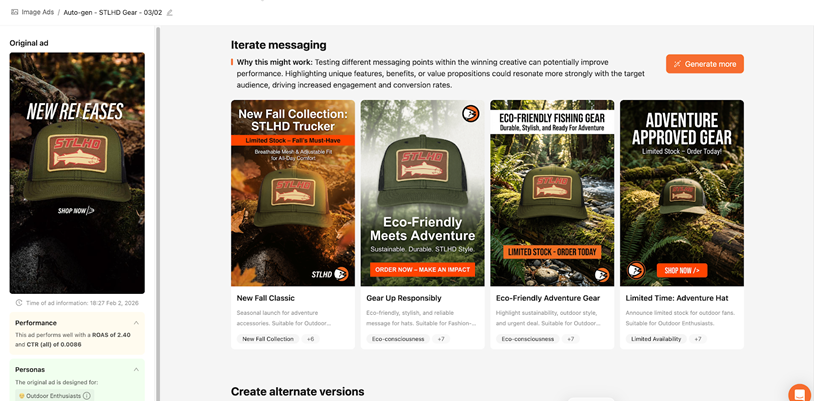
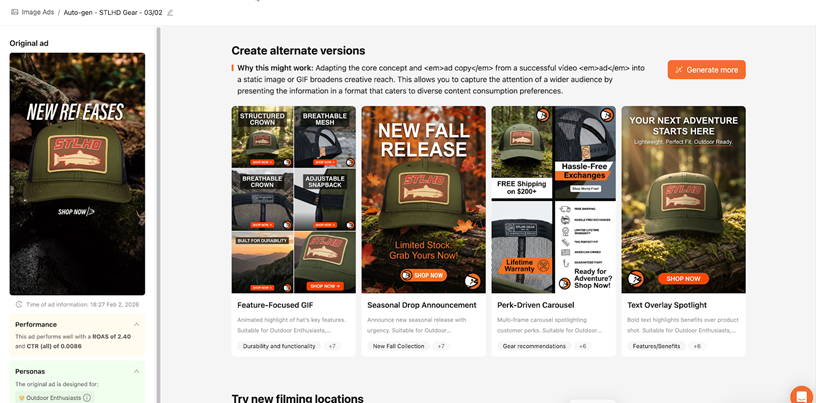
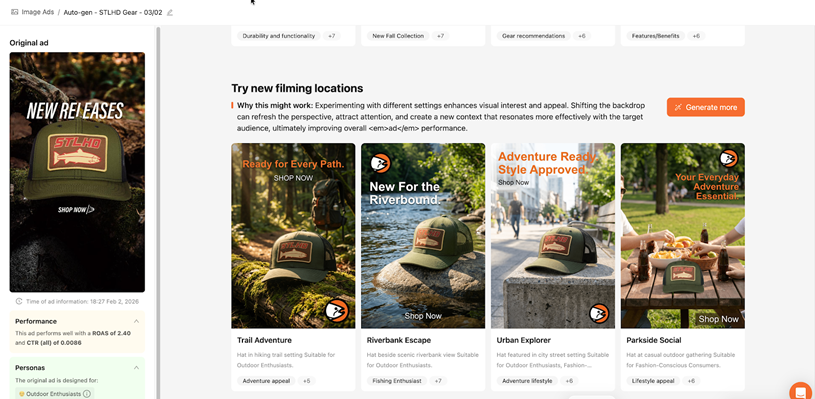
Not half bad, right? They’re great mockups showcasing how we could incorporate a diverse range of backgrounds, layouts, and messages. But, while impressive, none of these are close to final, ready-to-publish creative. Here’s why:
Many of the headlines aren’t on brand, and some of them cite non-existent value props.
The AI is generating product images, so it would be false advertising if we didn’t show a real photo of the client’s product.
Certain product close-ups don’t align with the messaging or are simply odd choices (like those mesh cap close-ups).
Several of the new backgrounds just “look like AI”... if you know, you know.
So while we have these new images that AI spun up in a snap, our creative team still has a lot of human-led work to do — like photoshoots, gathering detailed product info, asking the client questions, referencing their brand book, polishing design and ensuring it meets brand guidelines and platform requirements. And that’s before we get feedback internally and from the client.
Simply put, we might take about 25% of the AI-generated content as inspiration and toss the other 75%. To this day, we’ve never used an Atria-generated or any other AI-generated ad right out of the box — the technology just isn’t there yet. And while it will improve over time, it may always need tweaking to meet ours, our clients’, and their audiences’ standards.
From AI inspo to creative excellence
So what does AI help us with? It widens the field of possibilities: with faster analysis we gain more ideas, more examples, more copy and script options. It sharpens our strategy and decision making, while our human judgment and creative expertise determines what should actually move forward.
Here’s an example of an ad Atria generated — and the final product we made from that inspiration:
Atria generated:

Strategy Labs team created:

Our ad features a more specific product callout (suspension kits), an edgier subheadline, a real truck in the brand’s shop, a closeup of the real product inside the vehicle, accurate logos, on-brand typography, and a gritty textured background that adds more visual interest.
Meet us in the middle?
Atria provides just one example of our nuanced approach to AI usage, and this blog post truly only brushes the surface of our AI strategies. We’ve found a middle ground where a suite of tools assist us in accomplishing different tasks, but they certainly don’t complete the job for us. Quality ad creative still requires human thought and refinement.
If you’re looking to partner with a team who carefully balances efficiency with sound strategic thinking, you know where to find us.
Interested in seeing what Strategy Labs can do for you?